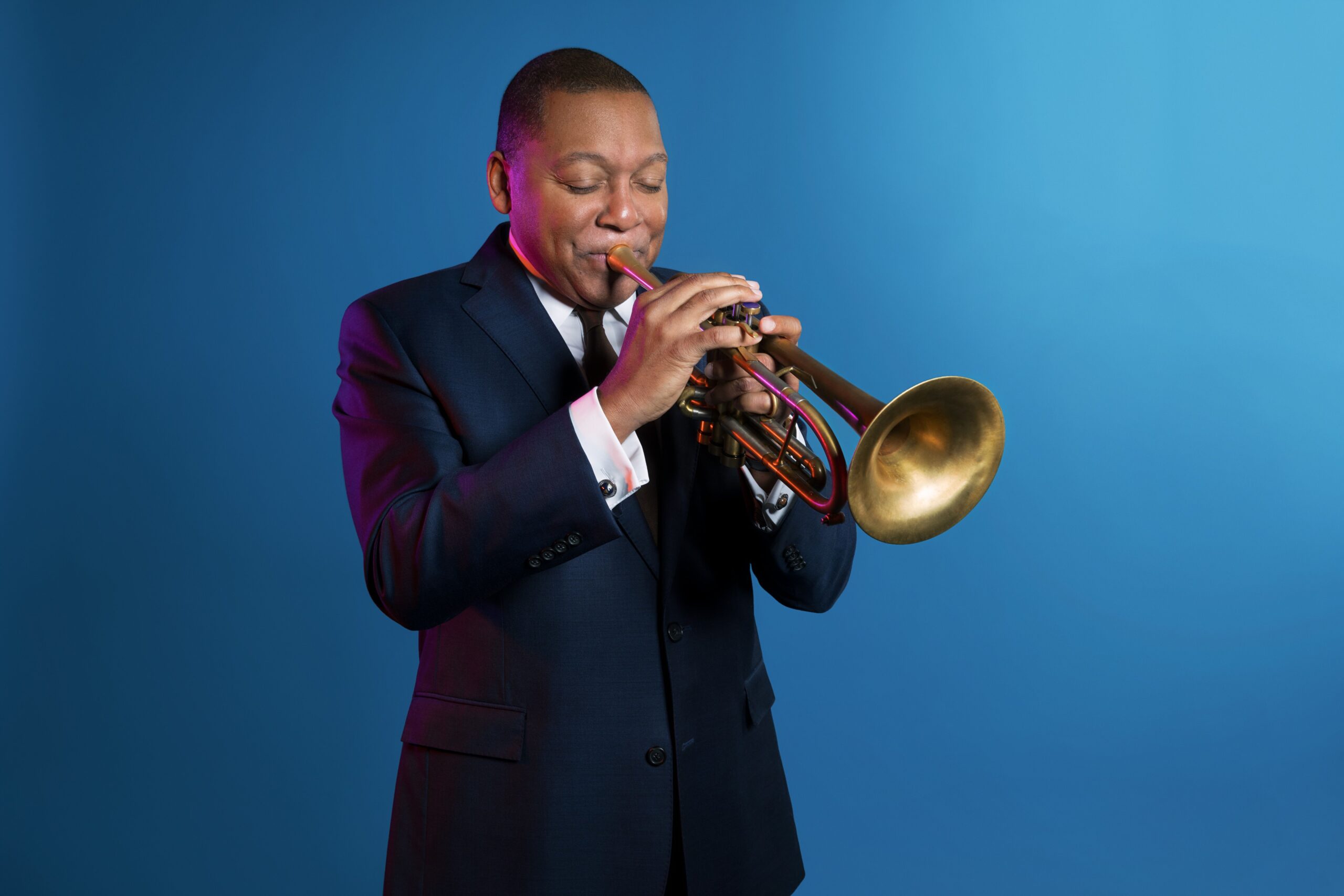
Although he’s lived many more years away from New Orleans than he’s lived there, Wynton Marsalis will always be associated with that storied and very musical city. Partially because his father, Ellis Marsalis, was a lifelong patriarch for jazz in the area, both as a pianist and educator. Partially because he received his first trumpet at the age of four from the local legend Al Hirt. Partially because he was the first of several younger jazz musicians to be signed by Columbia Records in the late ’70s and early ’80s – including his brother Branford, Terence Blanchard, Donald Harrison and Harry Connick, Jr. Partially because Wynton would later become a champion of both Louis Armstrong and New Orleans jazz. But that came later.
In fact, despite being raised in a jazz household and surrounded by live jazz in the neighborhoods, Wynton initially resisted the lure of that music. He and Branford preferred playing in a funk band called the Creators around town. In an interview Wynton did with Marcus Miller on one of our cruises a few years ago, he explained that jazz came later. “My father wanted me to take lessons from a trumpeter named Teddy Riley who we called Buck,” Wynton explained. “He played Louis Armstrong’s cornet when Louis Armstrong passed away. But New Orleans music didn’t interest us then. We thought we were the Crusaders. My father said, ‘Have you called Buck yet?’ I said to him, ‘No, I didn’t call Buck.” And later, ‘Did you call Buck?’ Finally, he said, ‘Man, you need to call Buck so you can learn how to play.’ I said, ‘Man, Buck can’t even read.’ My father said, ‘Son, people can either play or they can’t play. Look at you. You can read.’”
Wynton was soon listening to artists like Clifford Brown, Dizzy Gillespie and Miles Davis. “I started to wonder if I could learn how to play jazz,” he said. “Then I got a gig with some college kids playing at a club. When I was 15, they called the house and one guy, a bass player named Alvin Young, called the house and asked me, ‘Are you Ellis’s son?’ I said, “Well, yea, there are five of us.’ He said, ‘No, are you the one who plays trumpet?’ I said, ‘Yes.” He said, ‘Can you play a gig with us at this place called Tyler’s Bear Gardens?” I said, ‘What are y’all playing?’ He said, ‘You know, tunes like Chick Corea, Herbie Hancock.’ I couldn’t really play on changes at that time and I told him that I’m gonna be real sad. He said, ‘It’s all right. We’re all sad to start. You’ll get better.’” Indeed, Wynton did get better.
Ironically, it was classical music that brought him to New York City and put him on a path to international acclaim. Wynton was barely a teenager when an older musician introduced him to the virtuoso playing of classical trumpet Maurice Andre. “I said to myself, I wonder if I could learn how to play like him,” Wynton explained. “So I start practicing to play classical music off the record.” He was just 14 years old when he won a competition and performed Haydn‘s trumpet concerto with the New Orleans Philharmonic. Wynton has not forgotten his first rehearsal with that group. “When they played that first chord of the Haydn concerto, and that unbelievable big E flat chord filled the room, I got goosebumps,” he recalled. “The sound of it with 60 or so people playing it was so deep and full. All the times I’ve played concertos and played with orchestras, I always would go back to that first sound I heard.”
For Wynton, classical music offered him the opportunity to leave New Orleans. He had seen his father struggle economically as a local musician and he had also experienced racism in that city. After being admitted to the prestigious summer program at Tanglewood Music Center, Wynton applied and got into the Juilliard School. But like Miles Davis before him and Christian McBride after him, he left Juilliard to play jazz with his heroes, in Wynton’s case with Art Blakey and the Jazz Messengers.
That apprenticeship would lead to a storied career as a bandleader and composer and eventually the founding of Jazz at Lincoln Center, which has become the premier jazz organization in the world. More on that in a later edition of Jazz Notes. But despite being exposed to the music of Louis Armstrong, Wynton would only come to appreciate his genius later. “I was 17 and had a tape of Armstrong’s music,” Wynton said. “My father said I had to learn (Armstrong’s 1938 classic) ‘Jubilee.’ At the time I was learning solos by Freddie Hubbard, complicated things. ‘Jubilee’ was simple — and I couldn’t play it. Learning to play it made me understand I really had to study his songs. So, I started learning Armstrong’s music and his style. Being from New Orleans, I was aware of his style when I was young, from marching band and all the experiences he had, but I certainly didn’t know this was something you needed to study. We didn’t know the history well enough so we felt like Lous Armstrong was old-fashioned. We had a preconceived notion of him that kept us from appreciating how significant he was then and is now.”
During the last few decades Wynton has become one of the most foremost champions not only of Armstrong but of New Orleans jazz. That’s why it’s exciting for us to present Wynton and his group in performances in his hometown during Journey of Jazz ’27.
Lee Mergner
Jazz Consultant